Digital-First Meets Print: What the PEIQ Publishing Day Could Mean for Your Print Workflows
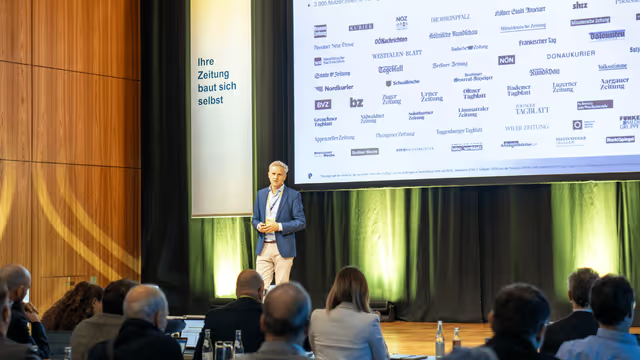
Under the motto "Your newspaper builds itself," around 140 representatives from the publishing industry met at the end of October at the PEIQ Publishing Day in Augsburg. For me, it was the second partner customer event since I joined Purple at the beginning of September. For two days, one central question took centre stage: How can print production and e-paper creation be automated in such a way that editorial teams and production teams are noticeably relieved without compromising on quality and creative freedom?



Brief Overview: My 3 Key Insights
- Digital-First as the key: Those who create content in a media-neutral way and enrich it with metadata can automate print production end-to-end—NOZ already produces 120 pages daily with automatic article placement.
- Flexible automation levels: Publishers determine themselves how much they automate. From fully automatic background placement to hybrid models where "flagship pages" are manually refined.
- E-paper scaling without additional effort: Automation enables product diversity: new editions on niche or in-depth topics are created without tying up additional personnel resources.
Insight 1: Digital-First as the Foundation for End-to-End Automation
Automation doesn't begin with layout, but with content creation. Publishers who switch to Digital-First and tag their articles with metadata create the foundation for automated print production. Many publishers still work with parallel workflows—the online editorial team creates for the web, the print editorial team manually sets pages. This not only costs time but ties up specialists in repetitive tasks. This is precisely where Digital-First CMS systems like Purple come in, supporting newspaper publishers in creating content once and distributing it across media channels.
Martin Huber, Managing Director of PEIQ, emphasised the necessity of this transition: Digital-First content is created once and then distributed across media channels—to web, e-paper, and automated print production.
NOZ bundles page production for 42 daily newspapers and relies fully on PEIQ. Around 120 pages are created daily with automatic article placement, whilst design-intensive "flagship pages" continue to be set manually. Karsten Grosser, Head of NOZ, explained that the standardisation of design elements and the preparatory optimisation of articles—meaning clean capture with metadata—are crucial for smooth operations.
Insight 2: Three Levels of Automation—From Dialogue to Background Placement
Automation isn't an all-or-nothing principle. Publishers can choose between different automation levels and combine them according to requirements. The central dilemma: control versus speed. Those who want to maintain complete creative control lose time. Those who want maximum speed give up control.
Nadine Frey, Head of Business Development at PEIQ, presented three automation levels in Augsburg that address this tension:
The ASSIST dialogue enables controlled automation. Editors provide articles and placement preferences, the system suggests layouts. The editor decides which layout is used. This variant is suitable for publishers who want to automate step by step.
The instant placement of page spreads creates several connected pages at the push of a button. Topic spreads or sections are created automatically, manual effort decreases significantly, design quality is maintained.
Automatic background placement offers maximum efficiency. Articles are tagged with topic area and placement instructions, the system creates the complete edition in the background. This variant is suitable for standardised products or e-paper variants.
Matthias Friedrich, Tech Strategy & Product Lead at PEIQ, explained that all three variants are based on the same technical foundations. AI-supported text adaptation optimises Digital-First content for the print channel—texts are shortened, subheadings adjusted, without editors having to intervene manually. André Apel, Head of Newspaper & Brand Design, added that the system is based on clear design rules: layouts are evaluated according to rhythm, proportion, and readability.
Insight 3: E-Paper Scaling Enables New Business Models Through Automation
Automation opens up not only efficiency gains in print production for publishers, but also new business models in the e-paper sector. Martin Schulze, Head of Products & Key Accounts at PEIQ, emphasised in his presentation the strategic relevance of e-papers, which are advancing to become an economic driver thanks to their curated form.
Through automation, the effort for creating additional editions decreases rapidly. Publishers can enrich their e-paper offering with additional pages or entire editions on niche or in-depth topics without tying up additional staff. The goal: retain subscribers and win new ones by offering readers exactly the topics that interest them. In the long term, this paves the way for personalised editions and new subscription models.
Mediengruppe Bayern, which produces 37 daily newspaper titles, shows how this scaling works in practice. Carolin Federl, Chief Editor on Duty, reported that they work with a hybrid workflow—depending on the timeliness and scope of an article, different approaches are taken. In the busiest month, 10,000 articles were managed across all channels—a volume that would be hardly manageable without automation.

Conclusion
The PEIQ Publishing Day 2025 made it clear: automation in print production is no longer a vision of the future, but lived practice. Publishers like NOZ and Mediengruppe Bayern demonstrate that significant efficiency gains can be achieved with Digital-First workflows and intelligent automation without compromising on quality or design.
If your publishing house invests in automated workflows now, you not only gain time and reduce costs. You also create the foundation for new products, personalised offerings, and a future-proof content strategy across all channels.
Would you like to find out how Purple can support your editorial team in transitioning to efficient, media-neutral workflows? Book a no-obligation conversation with our team and let's identify potential for your publishing processes together.
More practice. More details.
For a deeper dive, you'll find case studies, webinars, and insights from our daily editorial work, featuring concrete use cases, learnings, and best practices for Purple Prompts.

.avif)
Monthly updates you actually need.
Receive product updates, webinar dates, and brief practical insights on editorial, experience, AI, and integrations. Concise, infrequent, and spam-free.