INMA World Congress 2026: Three Publishers' Agentic AI Playbooks
How Holtzbrinck, Hindustan Times and Ippen Digital are already running AI agents in production, and why most publishers are still talking about it. John Rahim's recap from Berlin.

.avif)

For us, this year's INMA World Congress was a home game. The combination of international perspectives, concrete cases, and genuine exchange among peers makes this event one of the absolute industry highlights of the year, and the fact that it sold out well in advance speaks to the momentum the sector is feeling right now. Here's John Rahim's recap of the exciting Agentic AI seminar.
Holtzbrinck: getting into the room
The first question for any publisher serious about AI is where to learn from. Holtzbrinck's answer was to open an office in San Francisco. Katharina Neubert and Claire Furino presented Holtzbrinck's AI hub in San Francisco, now nine months old, staffed by two people and funded at less than 1% of group revenues. The point Neubert was explicit about: European publishers typically encounter AI companies through their sales functions. The people who build the products and the models are based in the Bay Area, and they are not the same people.
The hub operates across three layers:
- Signal-gathering and synthesis for group leadership;
- Knowledge transfer through an internal residency programme;
- Direct investment, with six companies backed since launch. The residency is deliberately non-technical.
Any Holtzbrinck employee can apply for a 3-month residency in San Francisco to develop a project from idea to MVP, typically in 11 weeks. Twenty-four to thirty projects have gone through the programme, ranging from a neuro-symbolic control layer sitting between MCP outputs and model results, to a book club app designed to surface audience signals that inform commissioning decisions. The latter was built by a staff member who, by her own account, had not worked with AI before joining the residency. Furino, who leads the technical side of the hub, described building the entire management infrastructure (application tracking, C-suite reporting across all seven business units, and an agentic layer for processing inbound requests) in 30 days with two people.

Key takeaways from the Holtzbrinck session:
- Physical presence in San Francisco yields access to the people building AI products, not just selling them.
- A residency open to non-technical staff accelerates cultural change alongside technical capability; it also changes how individuals think about what is possible.
- Shared tracking infrastructure converts individual project outcomes into institutional knowledge across the whole group.
- Investment positions the hub to generate returns that offset its own cost.
Hindustan Times: What full deployment looks like
Before the case study, Verma laid out why standing still is no longer an option. Audience trust is deteriorating: 40% of global readers now avoid news sometimes or often, up from 9% a few years ago. Print and digital revenues are declining across the board. And AI is redistributing traffic in ways publishers have limited ability to influence. When Google rolled out changes to Discover in September 2024, Hindustan Times was among those hit hard. Publishers dependent on the platform are reporting referral losses of between 20% and 70%.
The logic follows directly. If publishers are losing traffic to AI-driven search, the answer cannot be to run more pilots. The speed at which AI can compound internal capability is the only lever publishers directly control.

Hindustan Times Digital has moved past experimentation and is measuring outcomes:
- 97.4% of code is now generated by agents.
- Monthly code output has risen from 300,000 lines to 1.7 million with the same or smaller developer headcount.
- Engineering delivery timelines have improved by 60–70%.
- Sales cycle length has been cut by 40% through AI-generated pitch decks, produced in hours rather than five to seven days.
- Repeat client rates in advertising have improved by 20% through automated post-campaign insight reports sent directly to clients.
- 12 AI tools are currently in production; 10 more from a recent hackathon are being deployed this month.
The organisational model behind these numbers is as instructive as the technology itself. Hindustan Times identified AI evangelists in every department: not technical staff, but functional domain experts who act as translators between capability and application. AI adoption is now linked directly to performance appraisals: staff who are not using AI will not meet expectations. A public leaderboard gamifies adoption, with the most active users recognised at monthly all-hands meetings.
The governance structure is deliberate: a human reviewer sits at each stage of the agent pipeline, and quality-assessment agents audit the output of other agents. The goal is not to remove humans from the loop but to restructure where they sit in it.
Ippen Digital: the architecture question
Markus Franz, CTO of Ippen Digital and founder of its incubator lab, made the case for a different mental model. Stop thinking about individual AI tools. Agents are the operating system; skills (reusable, composable capability modules) are the applications built on top.
Ippen has built a suite of agents covering content research, SEO, audience analytics, and editorial quality assurance, orchestrated by a conductor agent that manages task allocation among specialist sub-agents. A content research workflow that previously took a journalist two to three hours now takes five minutes, scanning 300 articles and surfacing relevant material with full sourcing transparency.
Key practical observations from Franz:
- Agents should be treated like junior employees: they require onboarding, context, defined personas and explicit guidance on tone, priorities and editorial standards.
- Multi-agent systems require each agent to carry an "agent card," a defined identity that enables agent-to-agent communication across departments.
- Skills (reusable capability modules) are more durable investments than one-off agent builds.
- Interface design is the current bottleneck: most agent outputs are still delivered as walls of text that editors cannot work with efficiently.
- The adoption curve follows a predictable pattern: exploration, then specialised use cases, then genuinely novel workflows that emerge from the people using the system day to day.
Where the gap sits
The distance between the most and least advanced publishers in the room is not a technology gap. The tools are accessible, getting cheaper, and vendors are moving fast. What separates Hindustan Times' 97.4% AI-generated code output from a publisher still running manual marketing workflows is not access to better software. It is the organisational decision to treat adoption as non-negotiable, and to build the governance, the incentives, and the measurement frameworks that make it stick. None is waiting to see how it plays out.
From the stage to the partner dinner: When three partners and twenty publishing decision-makers share one table
Sometimes the most important conversations of a congress are not the ones on stage. On Wednesday evening, Piano, Purple, and conversario hosted a joint partner dinner during the INMA World Congress in Berlin.
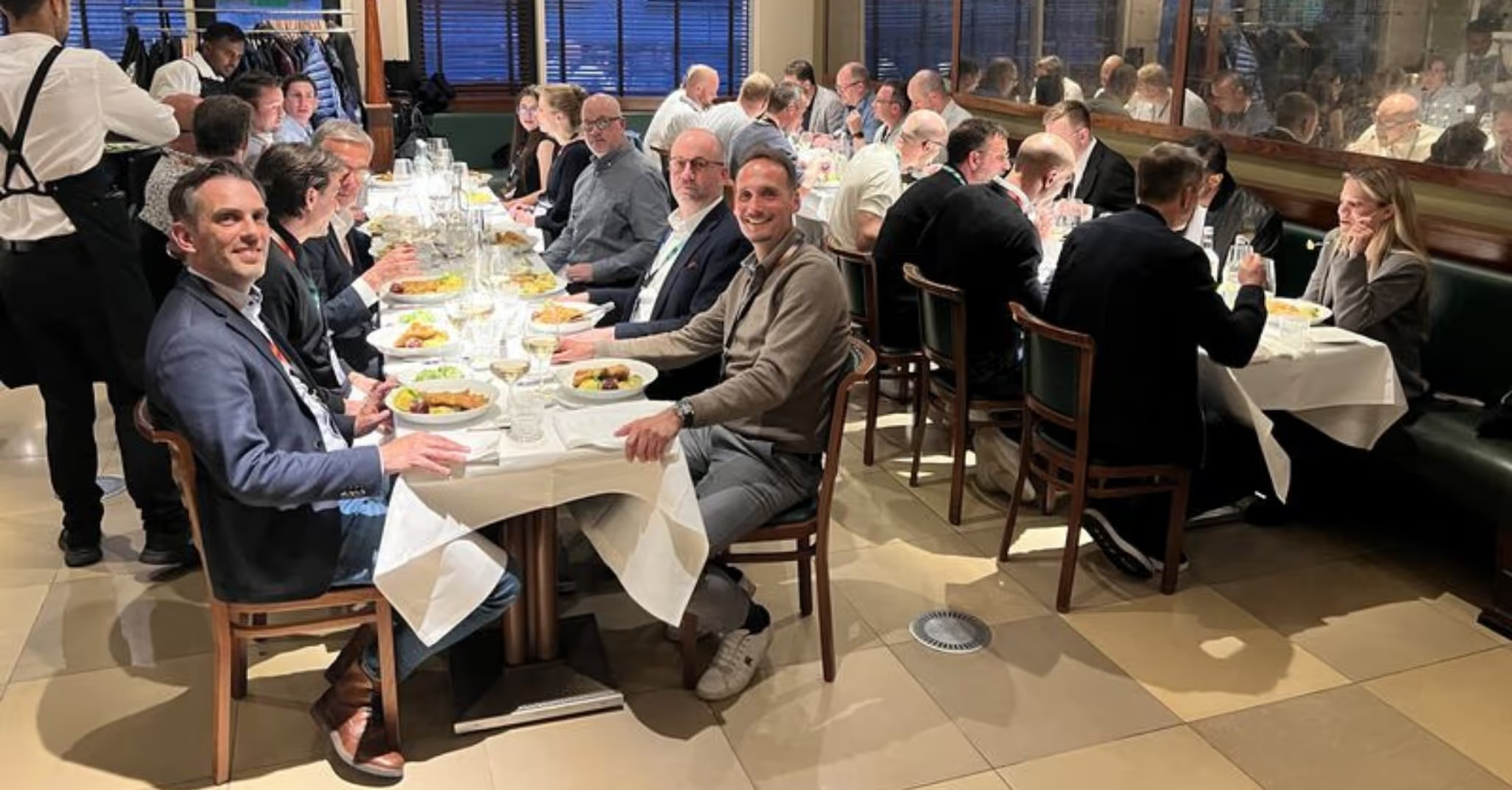
When three partners and around twenty publishing decision-makers share a table, all working toward the same goal of making publishers fit for the future, the best conversations tend to happen. Berlin as host city played its part. The diversity of the German publishing community was especially visible that evening.
For Purple, this year's INMA World Congress was a home game. Having the most important international industry event take place on our own doorstep made it a clear highlight of the year. Our thanks go to Clemens Hammacher (Piano) and Kevin Kallenbach (conversario) for co-hosting, and to every guest for an evening that gave real substance to the phrase "exchange among peers."
Über den Autor
John Rahim has been Purple's UK Advisor for years, looking after the platform's business across the UK and Ireland, from requirements analysis for new clients through to rollout. His roots are in digital publishing: he served as SPRYLAB's UK General Manager and still works with publishers such as The Telegraph, The Guardian and DMG Media. He also writes his own newsletter on publishing, advertising and AI.
More practice. More details.
For a deeper dive, you'll find case studies, webinars, and insights from our daily editorial work, featuring concrete use cases, learnings, and best practices for Purple Prompts.

Monthly updates you actually need.
Receive product updates, webinar dates, and brief practical insights on editorial, experience, AI, and integrations. Concise, infrequent, and spam-free.