10 Years at Purple: Rafael's Path to Head of Account Management
Ten years at one company is the exception rather than the rule these days. Rafael Diz Simon has been part of our team since December 2016 and has shaped several roles in that time: from Business Development Manager to leading the Customer Success team to heading up Account Management today. What brought him to us back then was the desire for variety and the opportunity to truly help shape things. The fact that this is not only possible at Purple but actively encouraged is what won him over and has kept him here ever since.

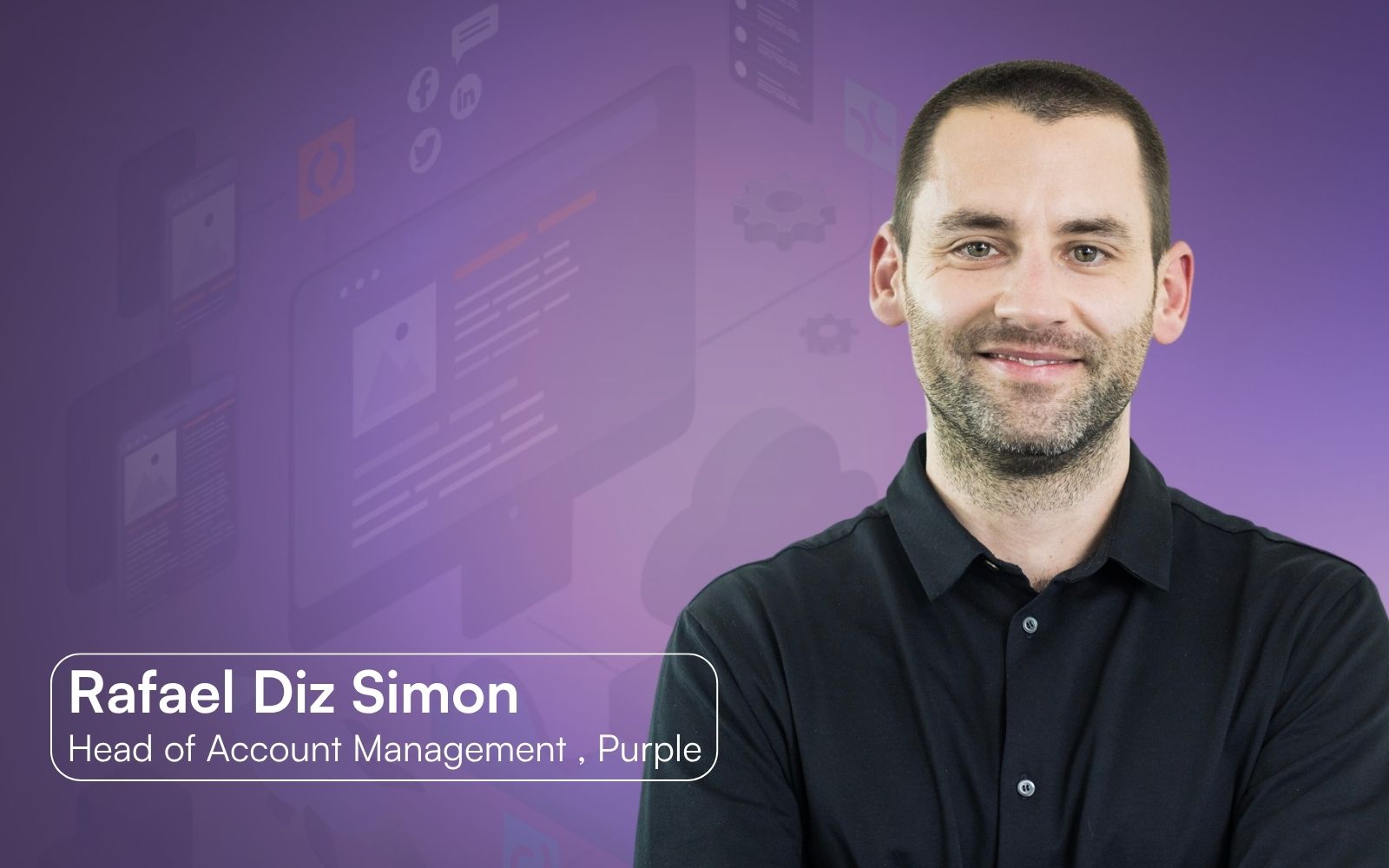

In this interview, Rafael talks about how his role has evolved organically, why the expansion of our customer documentation makes him especially proud, and what advice he would give new colleagues starting out.
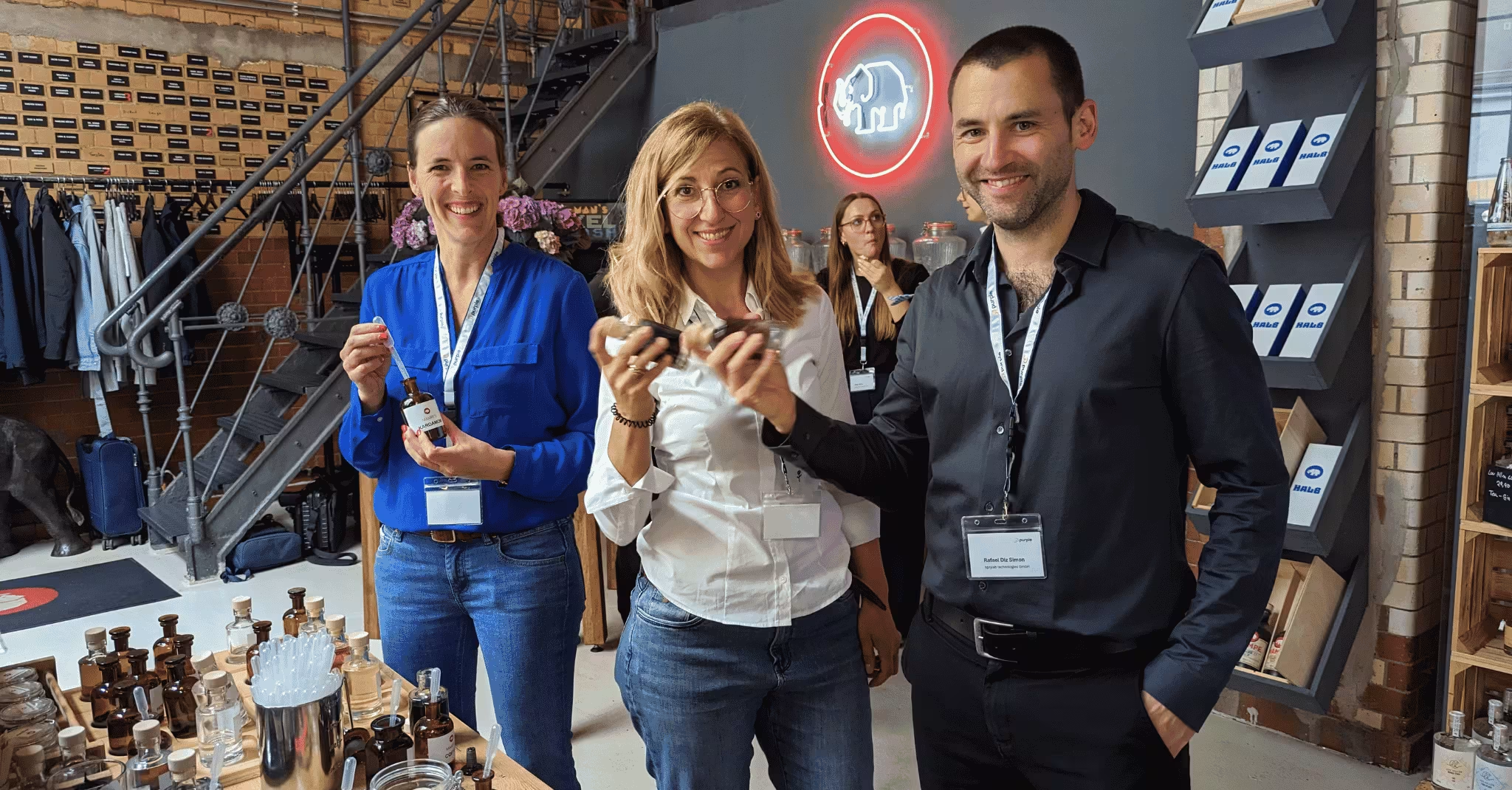
Rafael, you are celebrating your ten-year anniversary with us this year. Were you aware of that?
Yes, I was. I have thought about it quite a few times, especially in customer conversations, when you mention that you have been with Purple for many years. Ten years is a long time and it is remarkable how quickly it has flown by.
These days, long tenures are the exception rather than the rule, and many people have much shorter stints. So when you hear that someone has been with a company for ten, fifteen or even twenty years, it stands out. It also shows that the company and the role offer something that keeps people around for the long term.
Looking back ten years: What was your path before that, and why did you apply back then?
After my studies, I came to Berlin and first had to gain professional experience. I started with an internship at a start-up and then took a position as Junior Sales Manager, also at a start-up with a SaaS product in the link building and SEO space.
There I did classic sales work, with Salesforce, opportunities, sales stages and a lot of cold calling. That was a real challenge for me at first, because I had to step out of my comfort zone. At the same time, I learned a lot during that period, not just about sales but about dealing with people in general. At some point, though, the day-to-day routine there became too monotonous for me.
I did not want to go back into a purely classic sales role. What appealed to me about the position at SPRYLAB was that it was advertised as Business Development and explicitly included internal projects. So it was not just about sales, but also about helping shape things, driving topics forward and working with more variety.
Did that expectation come true?
Absolutely, and right from the start. Back then I was part of a small sales and marketing environment. That allowed me to get involved very quickly, work closely with my colleagues, give feedback, test ideas and take on responsibility. I quickly realized that working independently was not just possible but explicitly encouraged. That motivated me a great deal.
Your role has changed over time: from Business Development to Customer Success and now Account Management. How did that come about?
There were several reasons. For one, Purple evolved as a product. We broadened our scope, for example with the editor, and I was involved at various points, including the preliminary work on its selection.
At the same time, I worked very intensively with the product through countless customer conversations and by building showcases. That gave me a good sense of what works, where the hurdles are and what customers really need.
Our approach to customer support was also changing: away from purely reactive support towards a proactive customer success mindset. The focus shifted more towards actively guiding customers, suggesting improvements, implementing smaller projects directly and building the documentation in a way that enables customers to use the product more independently. In the end, it was a good mix of timing, product knowledge and my previous experience. The transition happened quite organically.
How would you describe your role today? What does a typical workday look like for you?
I still have a lot of customer contact today, but it is much more plannable than it used to be in support. A large part of my work is account management across all customers. The goal is to actively support every customer in some form, whether directly, through mailings, campaigns or feature reviews together with product development.
Beyond that, I look after important customers as key accounts. There are regular meetings for that, but also project-related coordination whenever new initiatives, brands or requirements come up.
I also work closely with the Customer Success team and sales. The commercial side, meaning quotes, contracts, licensing topics and change requests, deliberately sits with me and my team, so that Customer Success can focus more on implementation and support. That is why there is no such thing as a truly typical day. It depends heavily on what is currently happening with our customers.
Can you give an example of a personal success or a project that turned out particularly well?
The expansion of our customer documentation and the enablement measures in Customer Success. Back then, we had a product documentation that was rarely used and had become outdated. We then put a dedicated focus on it: better docs, clearer feature overviews, short release emails describing the benefits, and other measures to enable customers to get more out of the product. Internal onboarding was part of it as well.
We built that up really well together as a team, and the positive feedback even came proactively from customers, for example at our customer day. I found that especially rewarding, because you could tell that this work truly makes a difference.
What do you value most about SPRYLAB? What sets us apart from other companies in your view?
What I value most is the opportunity to take on responsibility and really move things forward yourself. That is not just possible here, it is actively encouraged.
I have experienced in corporate structures how slow things can become when processes are very rigid and run through many departments. It is different here. Of course we are building processes too, but in a way that still allows you to get involved and have an influence.
Then there is the culture around mistakes: You are allowed to try things out, learn from mistakes and take new paths. And I appreciate the relaxed way we interact, both within the team and across hierarchies.
If you could give new colleagues one tip for getting started, what would it be?
My most important tip would be: be hands-on. Take in as much as you can, listen, ask questions and actively seek out exchange with colleagues and also with customers. Precisely because Purple is complex and can feel a bit overwhelming at first, it helps a lot to absorb as much as possible, try things out yourself and build a clearer picture step by step.
Rafael's story shows how much growth is possible in ten years when initiative meets an environment that encourages it. From Business Development to building a proactive Customer Success approach to leading Account Management: At Purple, new roles emerge where people take on responsibility and drive topics forward. Want to advance your career with us? Then take a look at our careers page.
Über die Autorin
Gergana Schumacher has been with SPRYLAB since the early days. In People & Administration she keeps the team running in countless ways, large and small, and is an indispensable part of daily life at Purple.
More practice. More details.
For a deeper dive, you'll find case studies, webinars, and insights from our daily editorial work, featuring concrete use cases, learnings, and best practices for Purple Prompts.
Monthly updates you actually need.
Receive product updates, webinar dates, and brief practical insights on editorial, experience, AI, and integrations. Concise, infrequent, and spam-free.