Purple Connect 2026 in review: What we learnt about proximity, automation, AI and collaboration
Around 100 people from 59 publishers and technology partners, two days, four key takeaways. Here’s what happened at Purple Connect 2026, what we’re taking away and how you can join the next conversation.



Why Purple Day became Purple Connect
“Where will publishers’ reach come from in 2028? I don’t know exactly.” With these words, Stephan Heck, founder and CEO of Purple, opened Purple Connect 2026 on 4 November. That’s exactly why our customer event is no longer called Purple Day. Nobody has the one perfect answer yet. But if you put the ideas of many publishing houses on one table, you get the best possible estimate. And that’s something we can test together.
For our events team, and for me personally as head of marketing, it was a first: we’ve been organising workshops and one-day events for years, but a two-day event on this scale was new to us and something very special. For everyone who couldn’t make it, here’s a summary of what we’re taking away.
Purple Connect 2026 at a glance
- Participants: around 100
- Publishers and technology partners: 59
- Satisfaction in the feedback survey: 4.7 out of 5
1. Reach comes from proximity
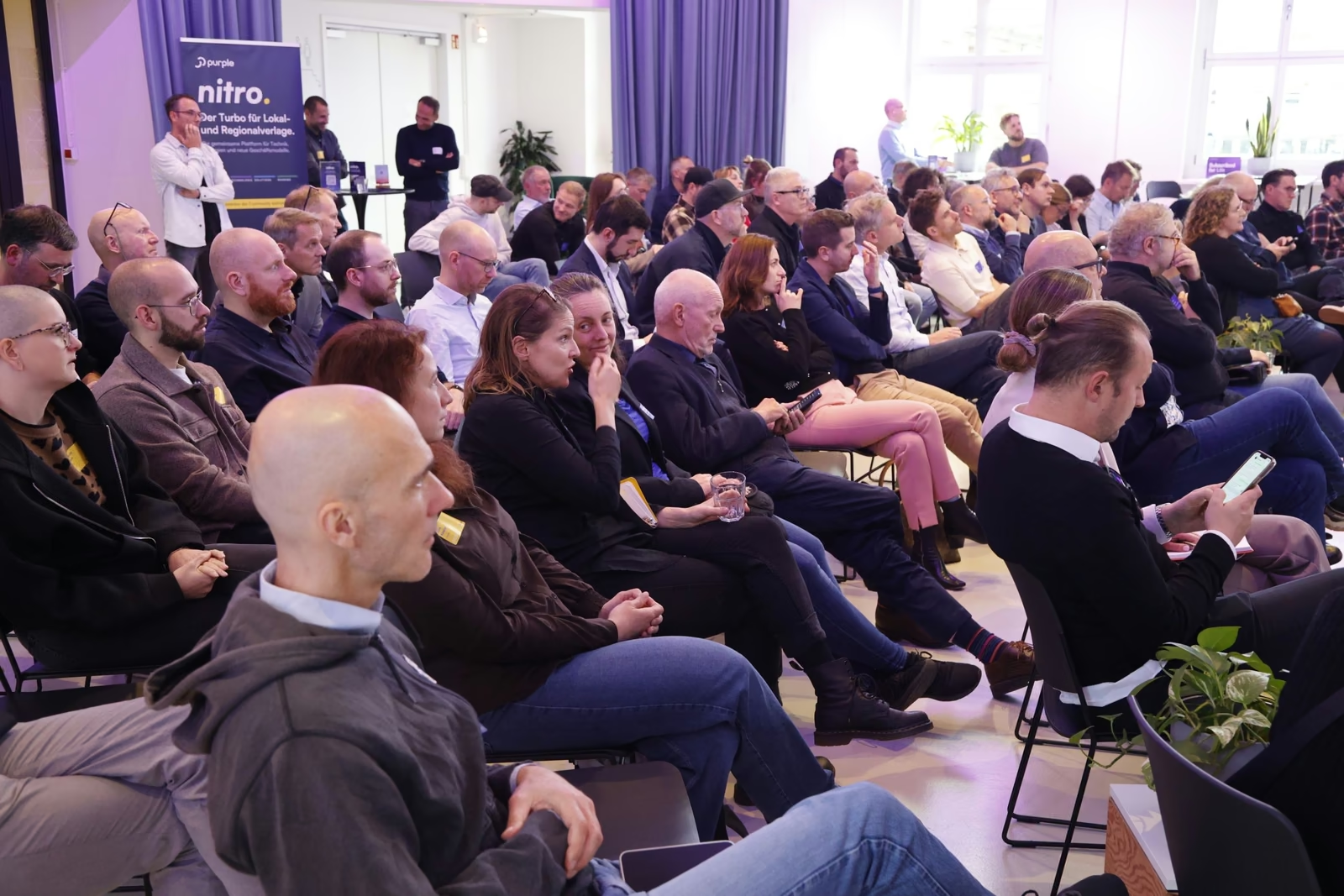
The keynote by Alexandra Borchardt, journalist, media researcher and Senior Research Associate at the Reuters Institute for the Study of Journalism at the University of Oxford, set the tone. Her central thesis: proximity is the new reach. This isn’t just about geography, it’s about connection. The journalism of tomorrow will win if it makes consistent use of technology while putting proximity and humanity first.

What this looks like in practice was shown, among others, by Thomas Hartung and Britta Linke from our customer gloobi.de. There, the newsletter is the core business, modelled on turi2 by Peter Turi. 13 permanent staff plus an ad sales team send around 90,000 newsletters across four brands every morning, free for readers and financed by around 5,000 ads a year. It shows how valuable a direct line to your audience really is.
2. More channels, not more people: automation is a must
Newsrooms are serving more and more channels, but their teams aren’t growing with them. Two customer cases showed how to solve this.
Echo Medienhaus: Michael Grassl-Kosa (Chief Digital Officer, Echo Medienhaus) and Matthias Fischer (Publishing Consultant, a&f) showed how the Vienna-based media house is automating its print production. Today, the level of automation is 60%, and it is set to reach 80% over the course of next year. On stage, a first fully automated layout of an entire edition ran in around one minute. For 2027, Echo expects savings of around 25%.

VDI Media: Ken Fouhy (Editor-in-Chief of VDI nachrichten and ingenieur.de) and Dr Marcus von Harlessem (Interim CDO, Markstein Software) shared how VDI Media is bringing all of its media onto one platform and working digital first. ingenieur.de, with around two million unique users a month, has been running on Purple since October. Its roughly 400,000 weekly newsletters are also created in Purple and then handed over to the email service provider Inxmail.
Automation isn’t an end in itself. It creates the space newsrooms need for new channels and formats.
3. AI, definitely, but used responsibly
Martin Wilhelm, Managing Director of Heidenheimer Zeitung, explained how AI is becoming part of everyday newsroom work. Around half of the roughly 30 people in the newsroom work with a ChatGPT account and their own skill library. A podcast featuring the day’s most important stories is created automatically. For the final proofread, the finished page is run through ChatGPT against defined rules and possible errors are flagged. The newsroom decides whether a change is accepted. Nothing is applied automatically.
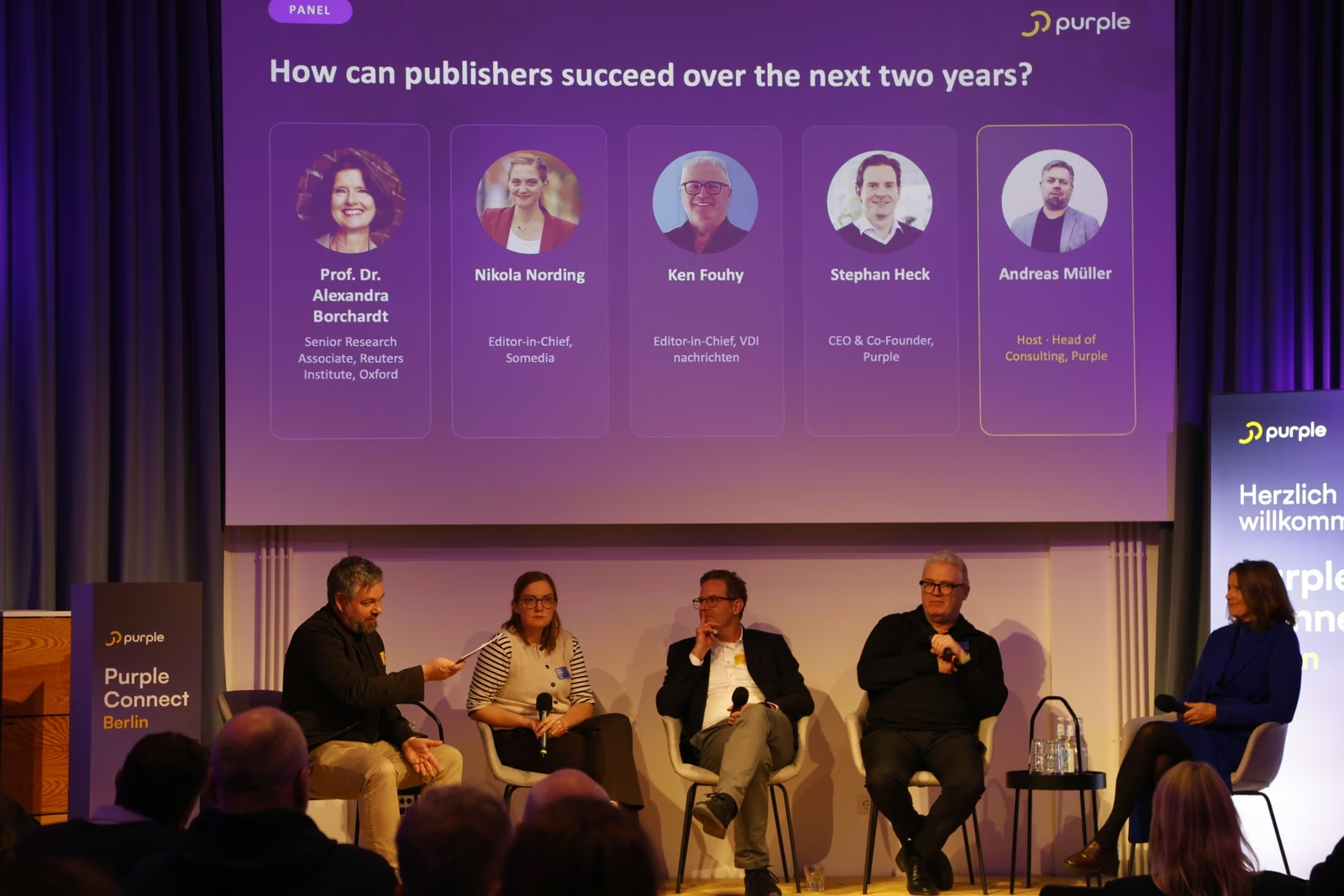
The same attitude shaped the panel with Nikola Nording, Editor-in-Chief Digital & Print at Somedia, Ken Fouhy, Alexandra Borchardt and Stephan Heck. At Somedia, an AI working group operates across the entire publishing house. Nikola Nording’s personal experience: texts are getting better overall, especially where there was the most room for improvement. Or, as Alexandra Borchardt put it: humans remain the anchor of trust.
4. Together instead of going it alone
Martin Wilhelm openly named the problem smaller publishers face: new developments and interfaces cost a lot of money. But users don’t care how small a publisher is. They expect the same quality as from Der Spiegel. His answer: cooperation, partnerships and nitro.
In print, this has long been standard practice. For its own edition alone, a printing press would run for around 30 minutes and then stand idle for 23.5 hours. That’s why Heidenheimer Zeitung has always printed together with partner publishers. Why should digital be any different?
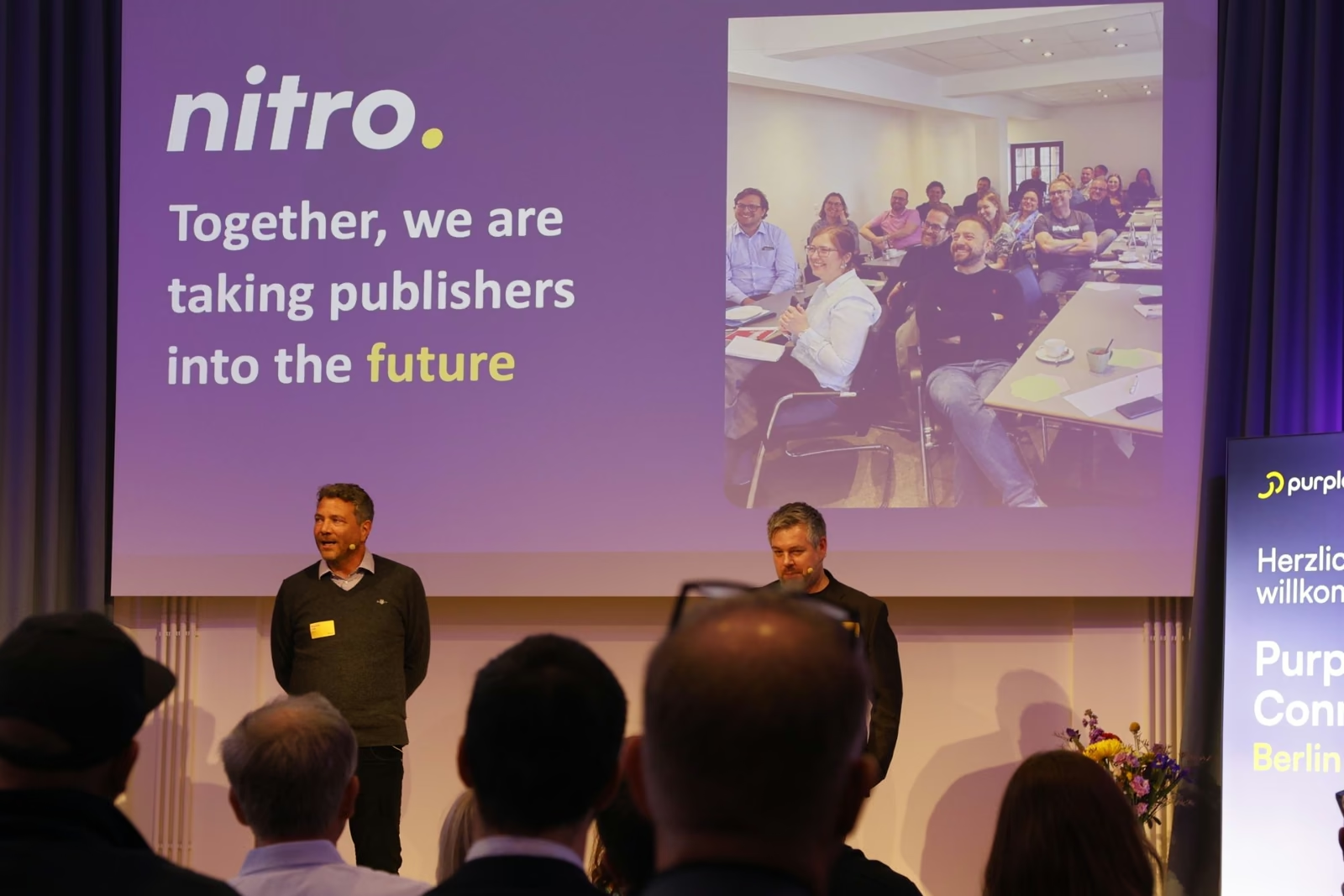
This is exactly the idea behind nitro, our initiative for local and regional publishers, presented by Benjamin Kolb and Andreas Müller: individual journalism, shared infrastructure.
Our ecosystem in speed-dating format
Purple relies on best-of-breed solutions for every use case rather than isolated systems. Six selected partners introduced themselves in short lightning talks:
- Kordiam (Giorgio Chiara): Editorial planning, synchronised with Purple in both directions.
- Sternwald (Bastian Metz): Digital asset management for images and media.
- ferret go (Kevin Kallenbach): Community management with conversario and engagently.
- ppi Media (Dr Thomas Müller-Lupp): Print production straight from the digital article.
- beatsquares (Peter Dyllick-Brenzinger): Automatically generated podcasts from articles.
- CmsPublisher (Juha Siintola): A plug-in that transfers content from Purple directly into InDesign.
Day 2: Where Purple is heading
Day two was all about our headless CMS and our experience platform.
Digital Edition and apps: Benjamin Kolb, CTO and co-founder of Purple, demonstrated how publishers can bring a journalistically curated, self-contained product into the digital world. News, e-paper and Digital Edition all run on the same technology.
Web and app templates: Adrian Gronwald, COO of Purple, presented the new templates for websites and apps: a modular toolkit, built once and rolled out across many brands. Andreas Müller aptly called it “nitro you can touch”.
AI in the publishing platform: Benjamin Kolb showed how AI workflows take over routine tasks at every level of the platform, from the newsroom to IT.
Roadmap: Stephan Heck, Thomas Beernink and Maximilian Moll gave an outlook on 2027 and demonstrated new features live in the Purple Hub.
What you only experience on site
Talks can be summarised afterwards, much of the rest can’t. At the topic tables, the product team answered questions directly and many conversations went far beyond the programme.
The evening of day one was spent at Freischwimmer, a venue right on the water with lots of wood and an open fire. The pub quiz, prepared by our Head of Customer Success Kolja Kosim, wasn’t just about bragging rights. The winning teams chose the causes we donated to on their behalf: Verein Momo, the Paderborn animal shelter and the Familienbund der Katholiken im Erzbistum Paderborn.

Nothing replaces meeting in person
What I’m personally taking away: many of the best conversations of these two days weren’t on any agenda. Thank you to all our guests, to the speakers who shared their projects so openly, hurdles included, and to our partners. And thank you to our team: the 4.7 out of 5 is mostly down to you.
Our event playbook is certainly a few pages thicker now. And one thing is for sure: this wasn’t the last Purple Connect.
Stay involved
Recordings and slides are available to attendees. If you couldn’t make it, there are two ways to stay involved.
The nitro community for local and regional publishers: Getting started is free and non-binding. The next sessions take place online on Tuesdays at 11 am CET and are held in German:
- 24 November 2026: Press inbox: fully automated classification and structuring of emails
- 1 December 2026: Liquid Content: quality journalism that reaches audiences where they consume content
- 15 December 2026: Purple AI Analytics: metrics beyond the click
You can register at purplepublish.com/en/nitro-anmeldung.
Our newsletter: Subscribe to be the first to know when and where our next events take place. Sign up here.
And if you’d like to talk to us beforehand, drop us a line.
Über den Autor
Timo Lamour leads marketing at Purple. He studied media studies and worked as a freelance contributor at the daily newspaper Die Glocke before joining Purple in 2017, where he grew from working student to Head of Marketing.
More practice. More details.
For a deeper dive, you'll find case studies, webinars, and insights from our daily editorial work, featuring concrete use cases, learnings, and best practices for Purple Prompts.


Monthly updates you actually need.
Receive product updates, webinar dates, and brief practical insights on editorial, experience, AI, and integrations. Concise, infrequent, and spam-free.